3D harmonic Model © 2016~2025
US Patent #: 9947304.
Representing Music
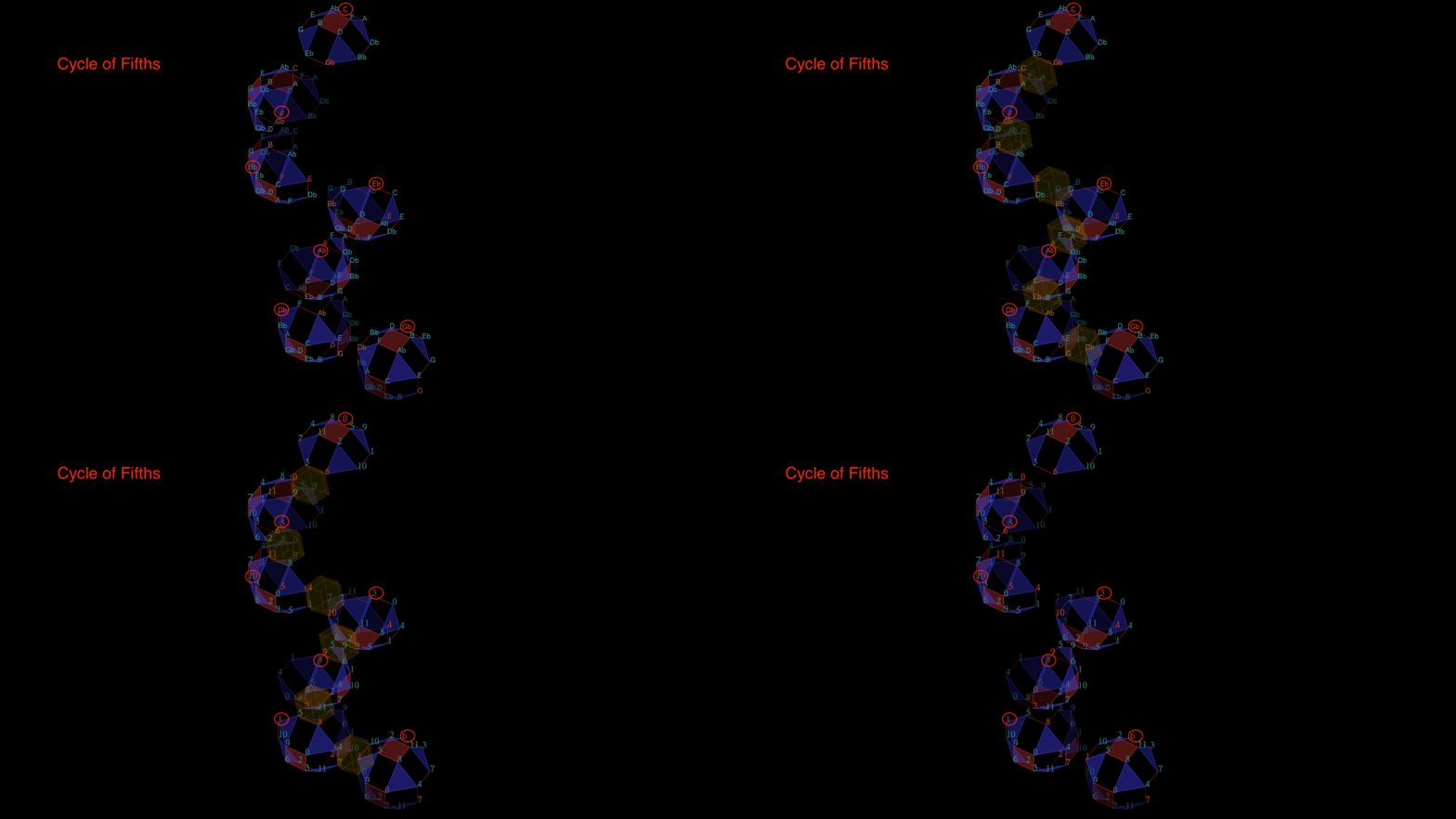
Just as there is no sense in playing all scales at once, we cannot represent all scales at once. However, the Model provide a way to represent a logical progression from one tonality to the next. It is in this shifting that we find meaning.
fig.25 Cycle of Fifths in the 3D Space
From One Scale To The Next
One Note At A Time - Bb Scenario -
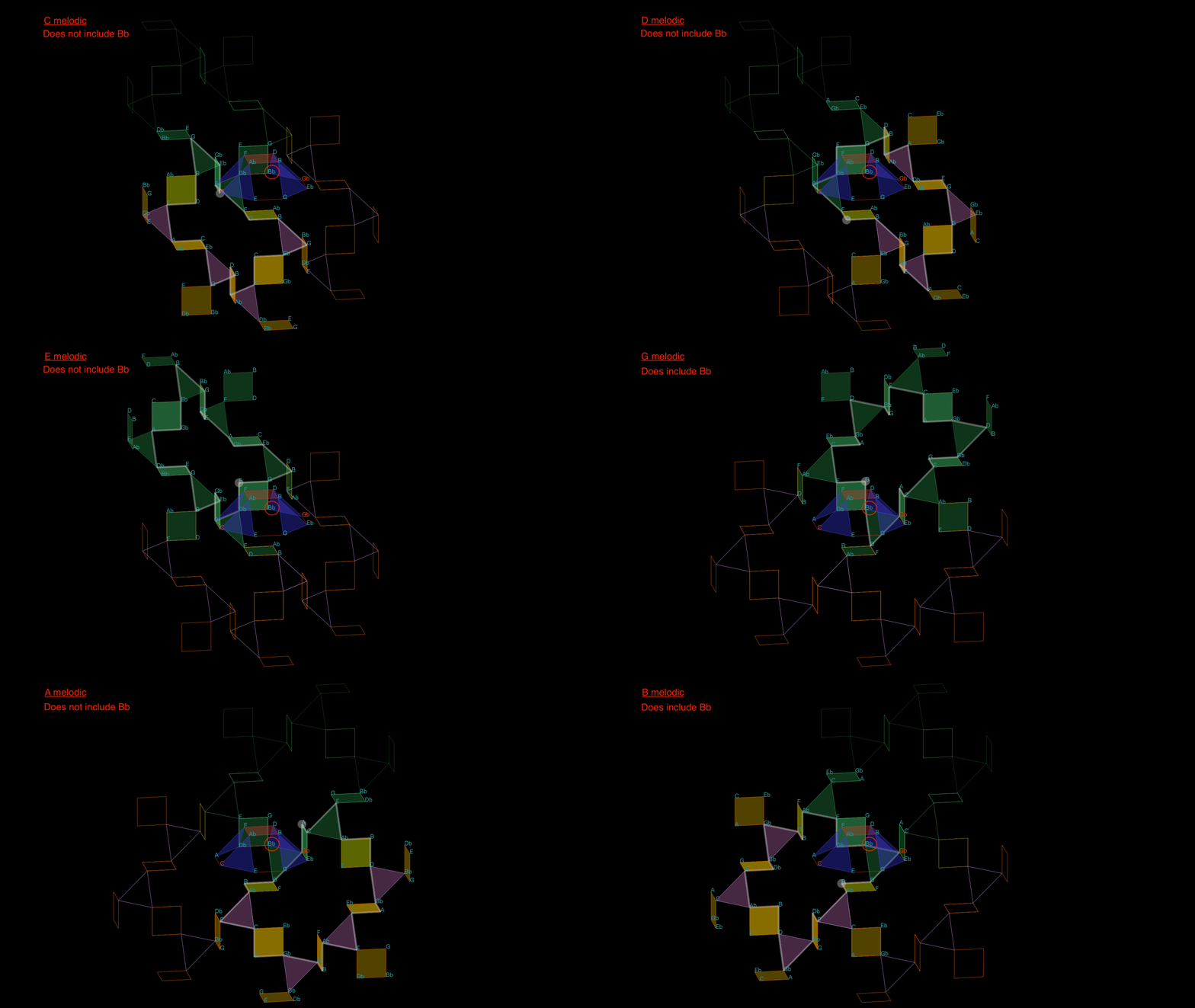
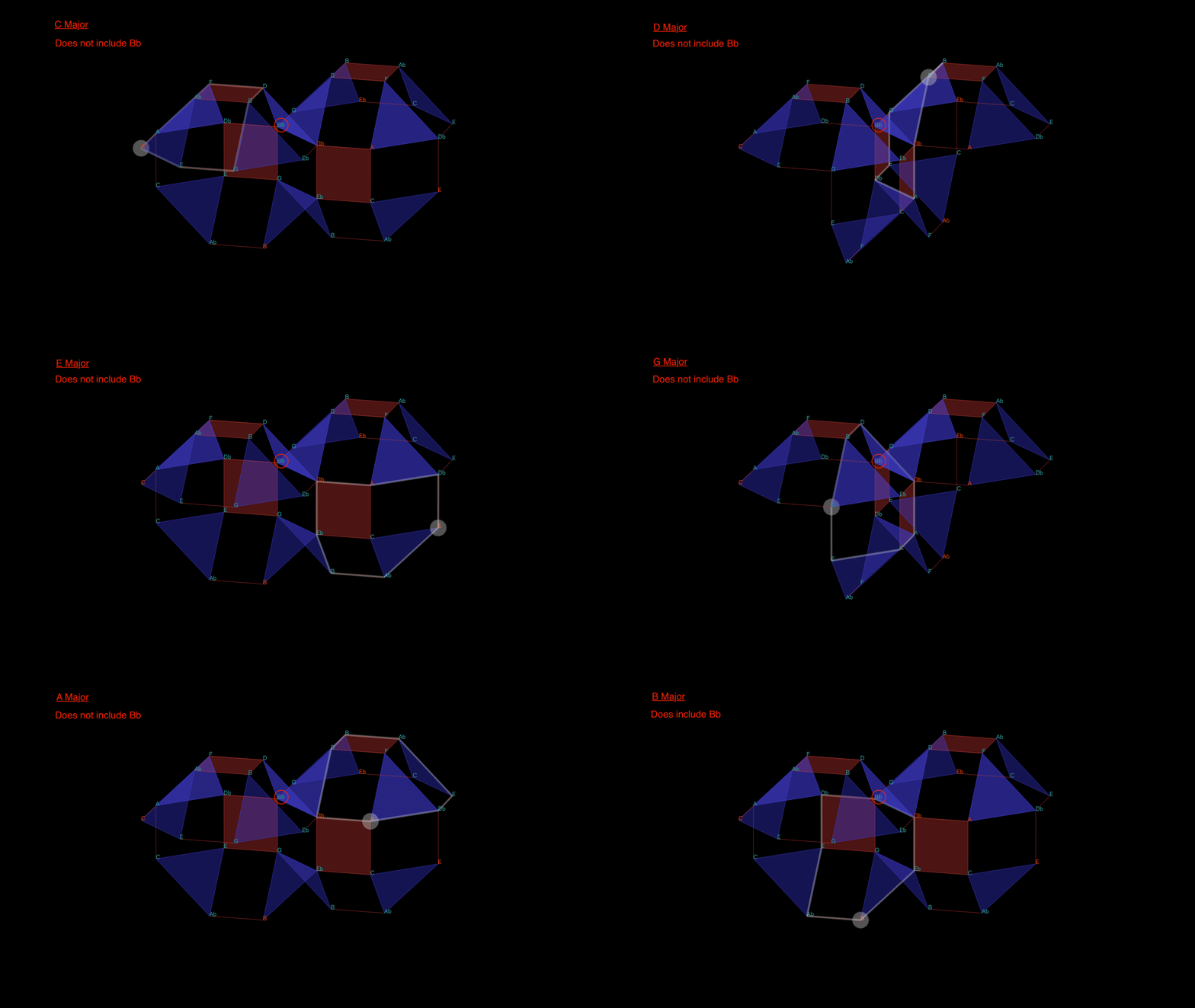
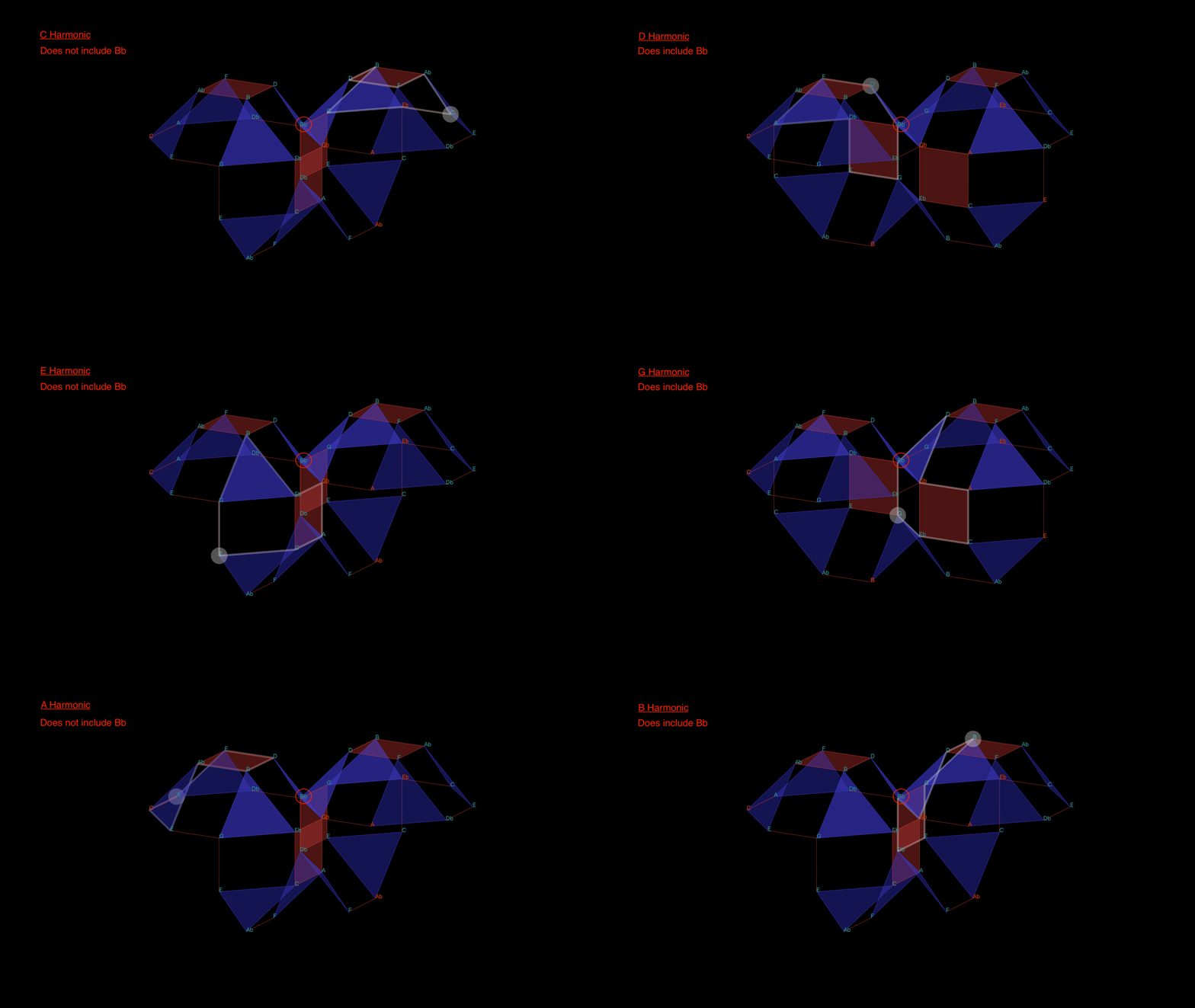
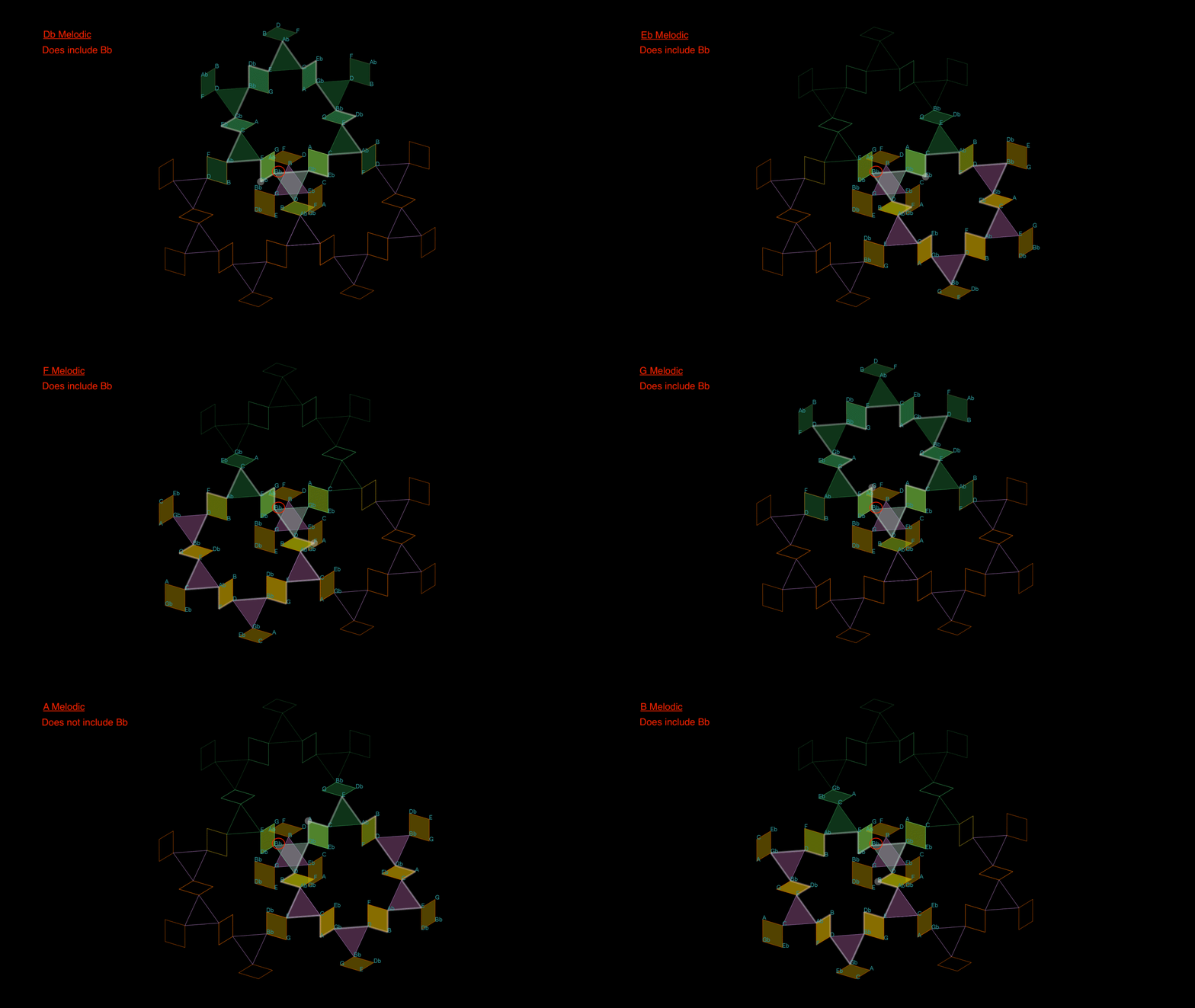
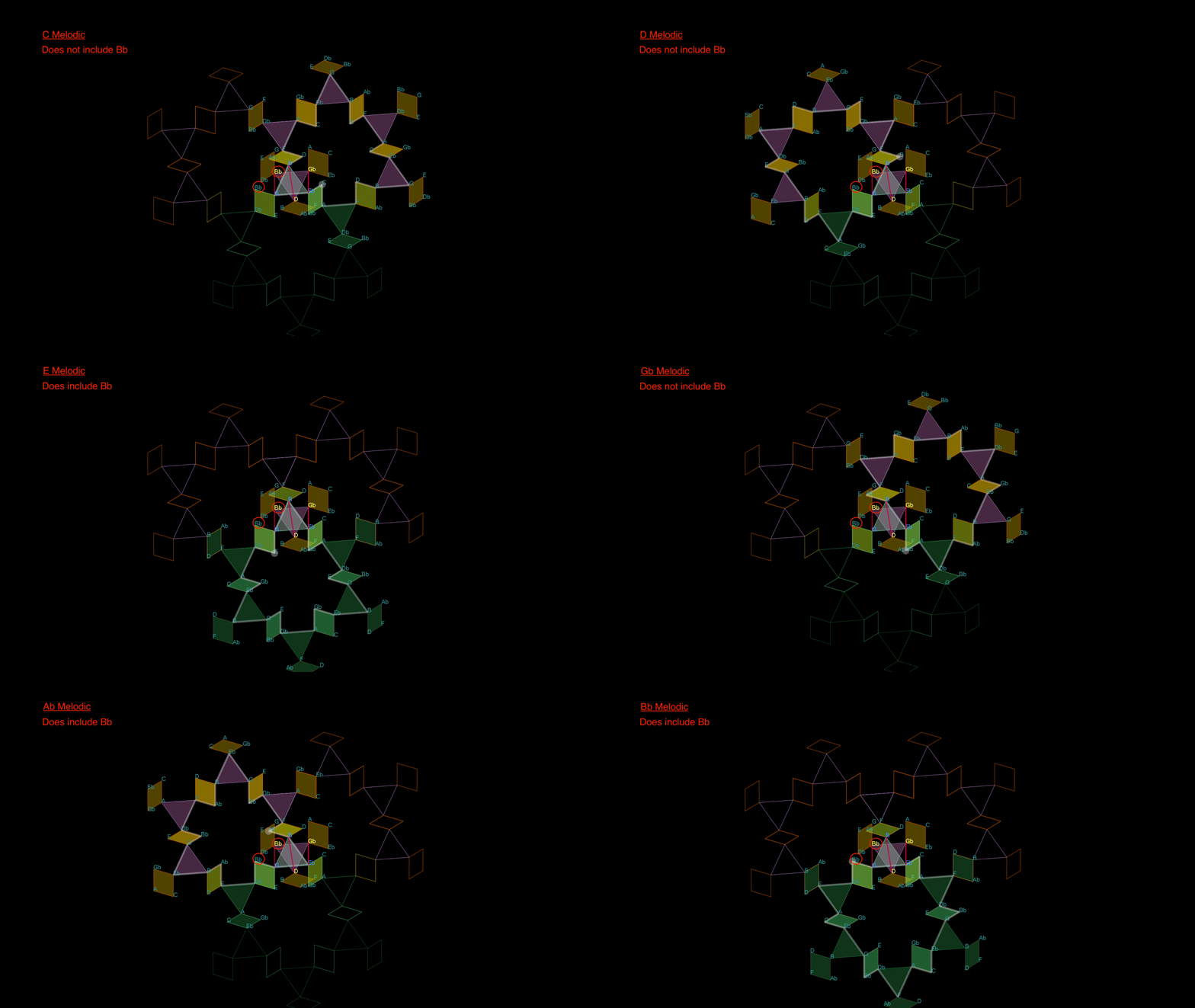
The model allows us to 'see' which scales, a note is part of. On the following series of images, we'll see all the scales that include Bb, and all the ones that does not. Notice how each scale has a unique place in the 3D space.
Going From Major To Melodic
fig.25a Bb Notes' Relationship To Every Melodic Scales
Going From Major To Major
fig.25b Bb Notes' Relationship To Every Major Scales
Going From Major To Harmonic
fig.25c Bb Notes' Relationship To Every Harmonic Scales
Going From Melodic To Melodic
To find out if a melodic scale includes a specific note from a diminished context we used the two complementary contexts pairs, hence keeping us centered on the diminished context. Here, in order to show all twelve melodic scales we'll need to use the augmented system.
We already saw that there are six melodic scales intersecting one augmented context.
We already saw that there are six melodic scales intersecting one augmented context.
fig.26a First Six Melodic Scales
Bridging Two Augmented plane
But for the next six scales which are part of an other augmented plane, one that does not 'touch' nor share notes with our previous six melodic scales, we need to use the minor third connections described earlier between the two planes —see fig.22 .
Here are the next six melodic scales.
Here are the next six melodic scales.
fig.26b Remaining Six Melodic Scales
Going From Melodic To Major
This time we are centered on a B melodic scale and looking at intersecting major scales.
fig.26c Twelve major Scales
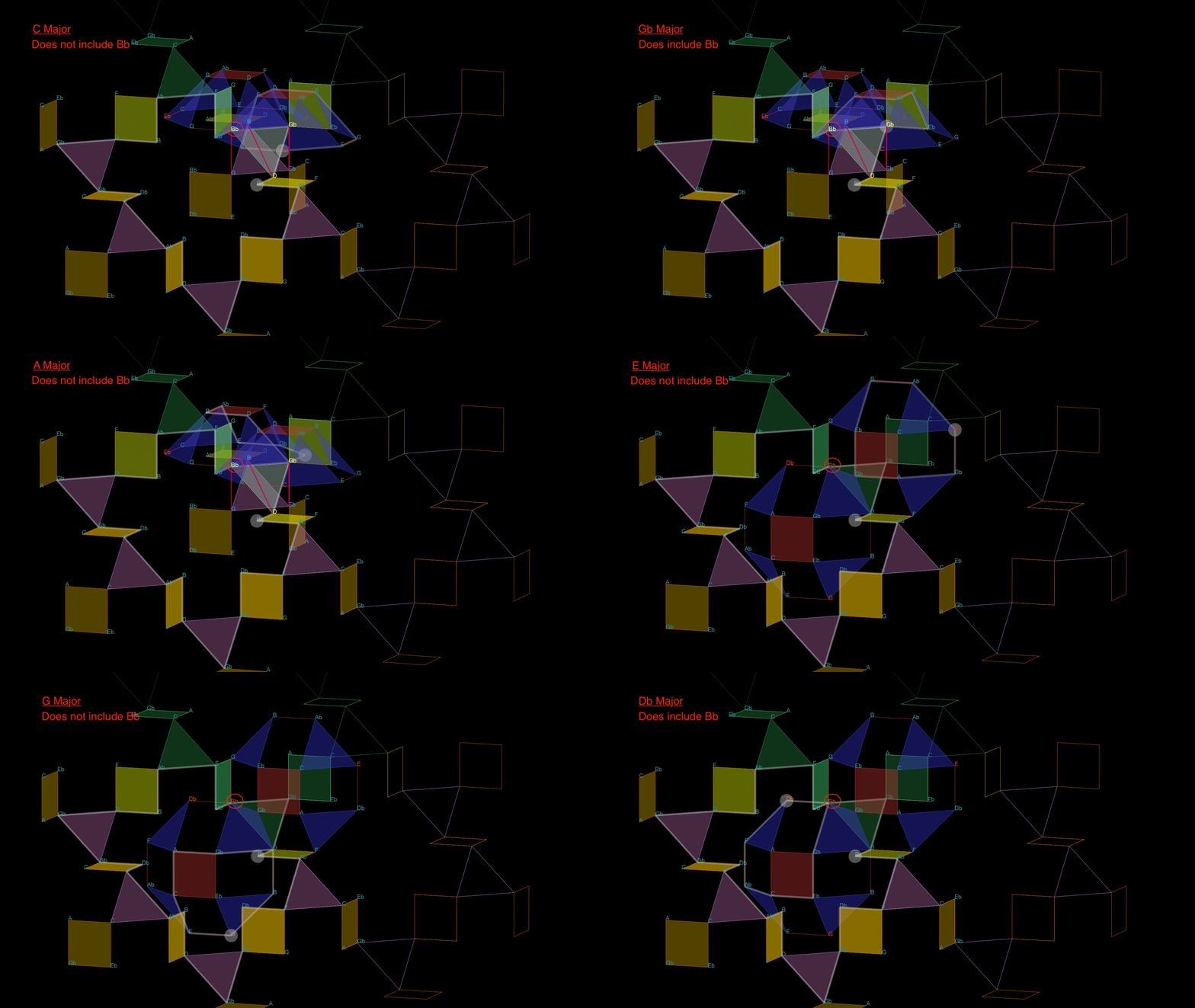
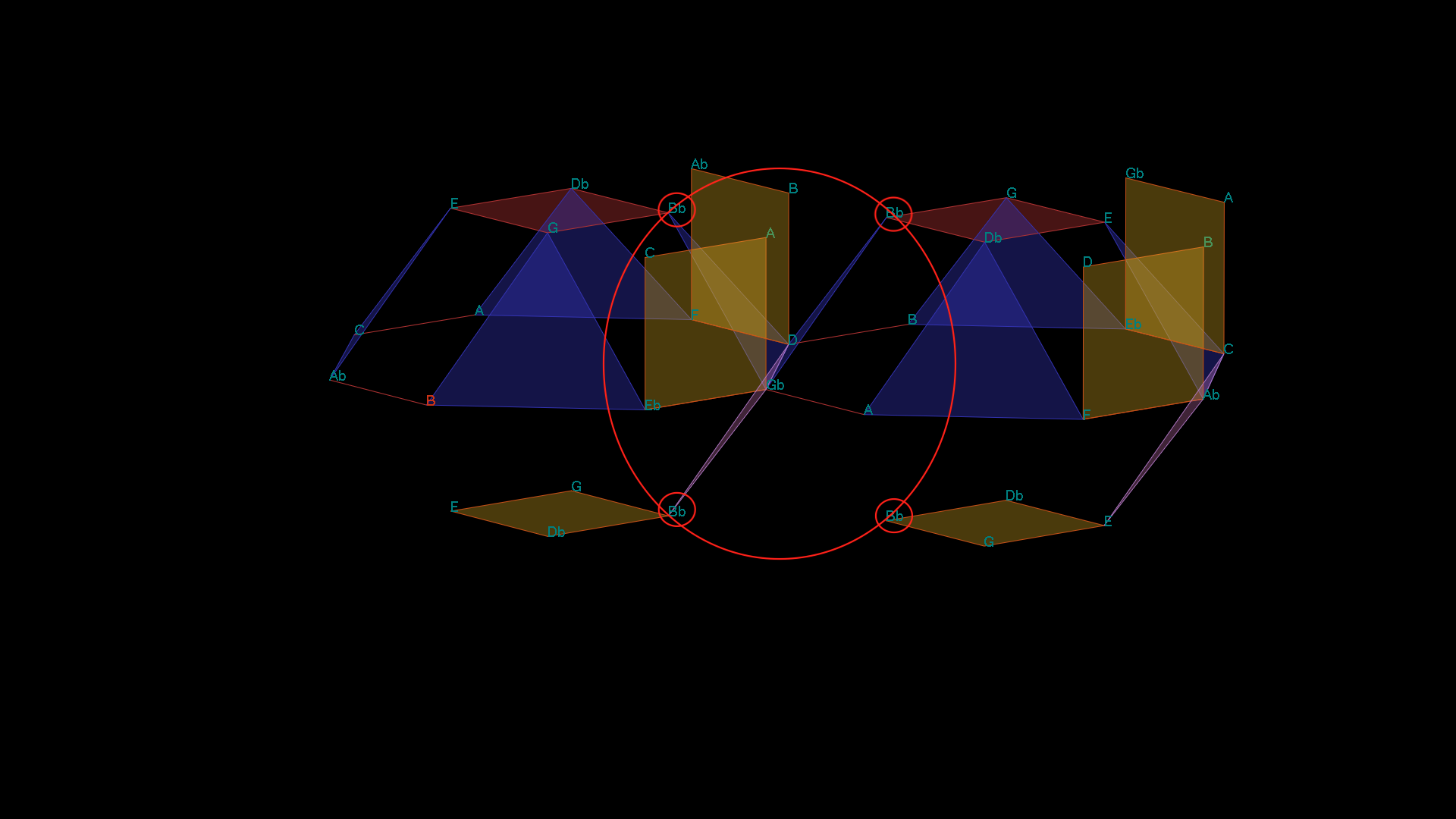
Because the Rhombicuboctahedron is not a space filler, when considering notes from the diminished square, or the corresponding augmented square, note equivalence have to be established in the graphic interface — An animation might be needed, software that will use the model will have to implement it!
fig.26x
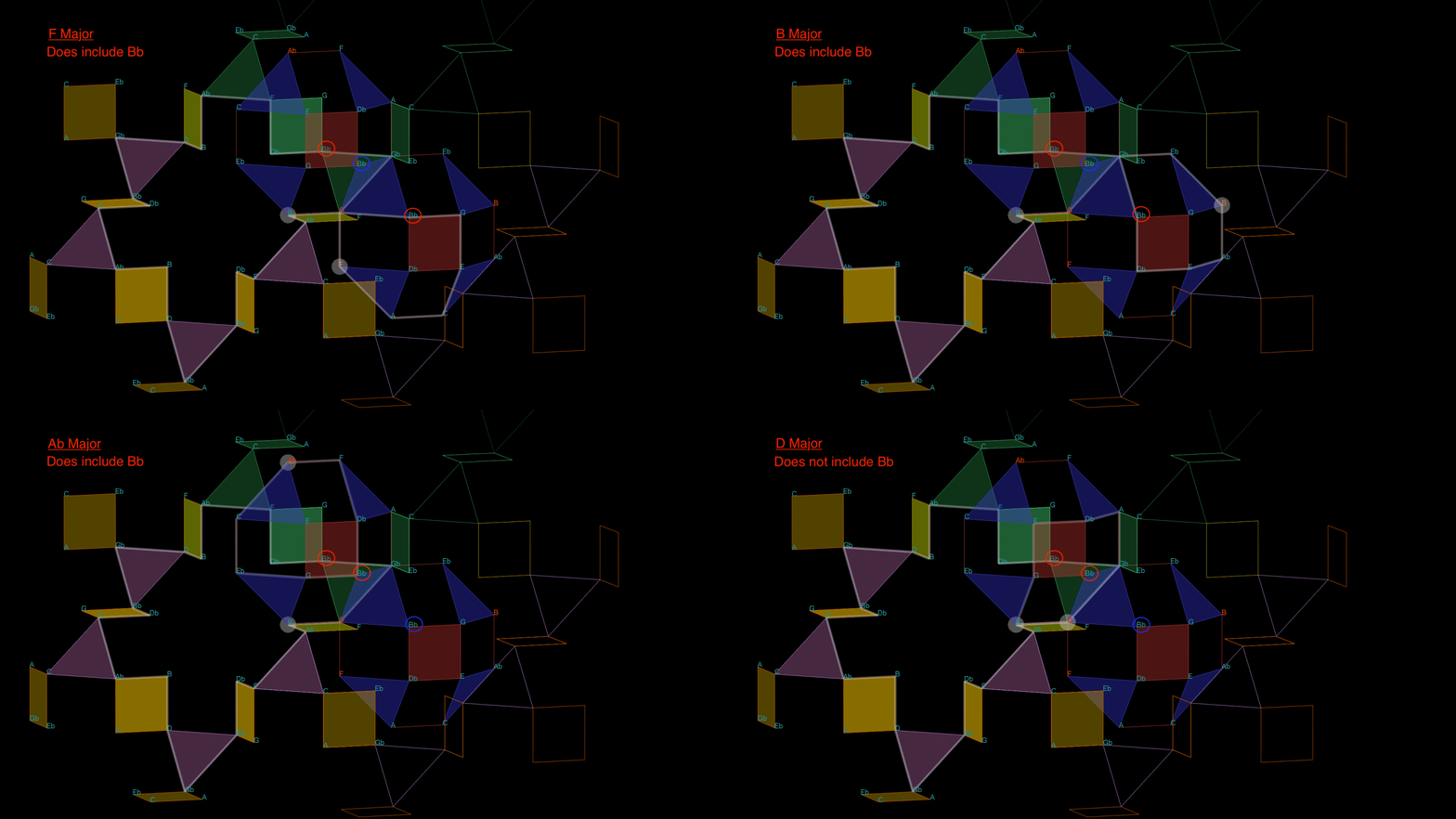
With that in mind, here are the remaining four major scales, which happen to be D, F, Ab & B, the diminished square of our starting C context.
fig.26d Remaining Four Major Scales
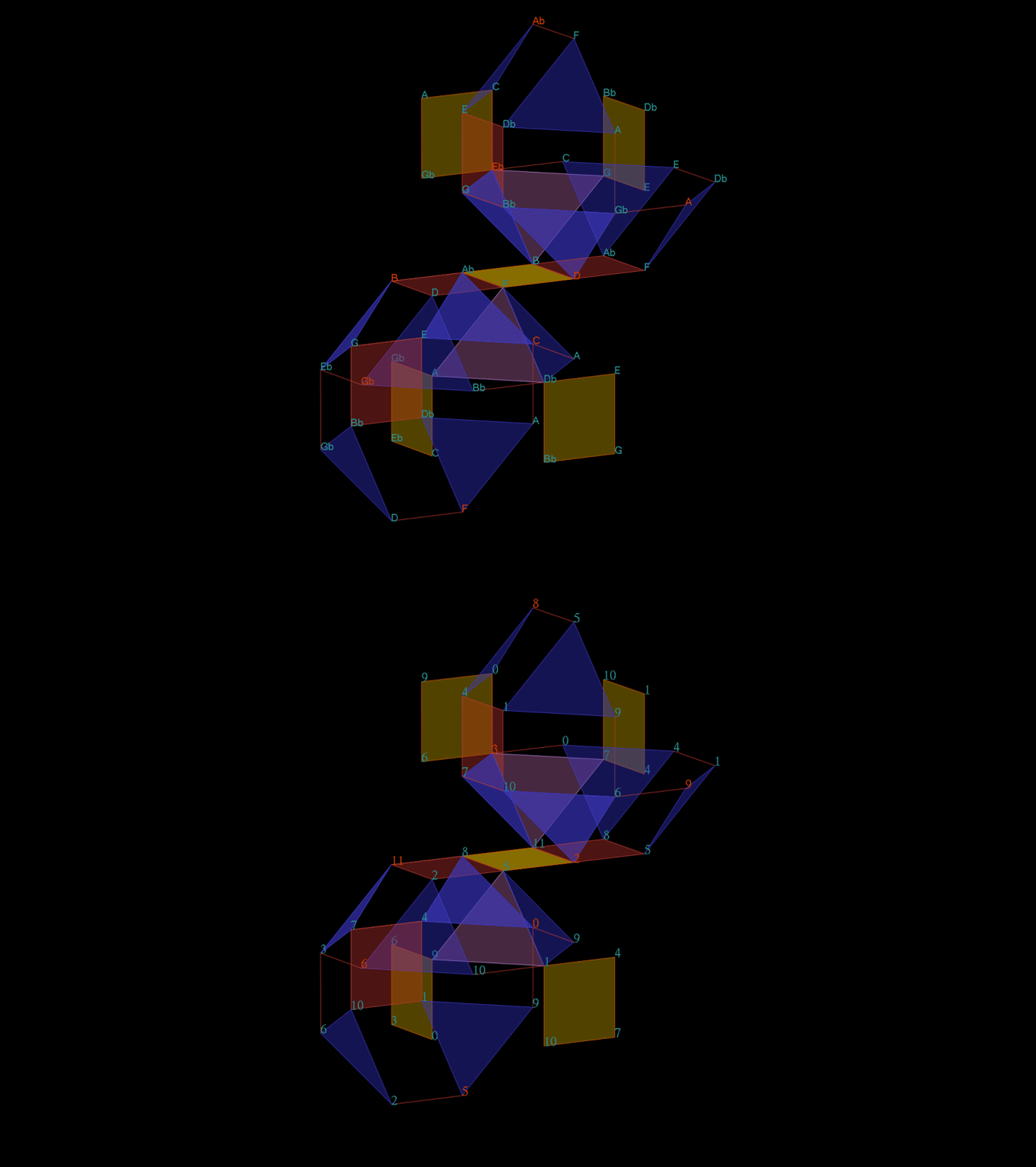
I haven't implemented this... But we should be able to solve this like this;
fig.26e
The Symmetrical Diminished And The Symmetrical Augmented Scales
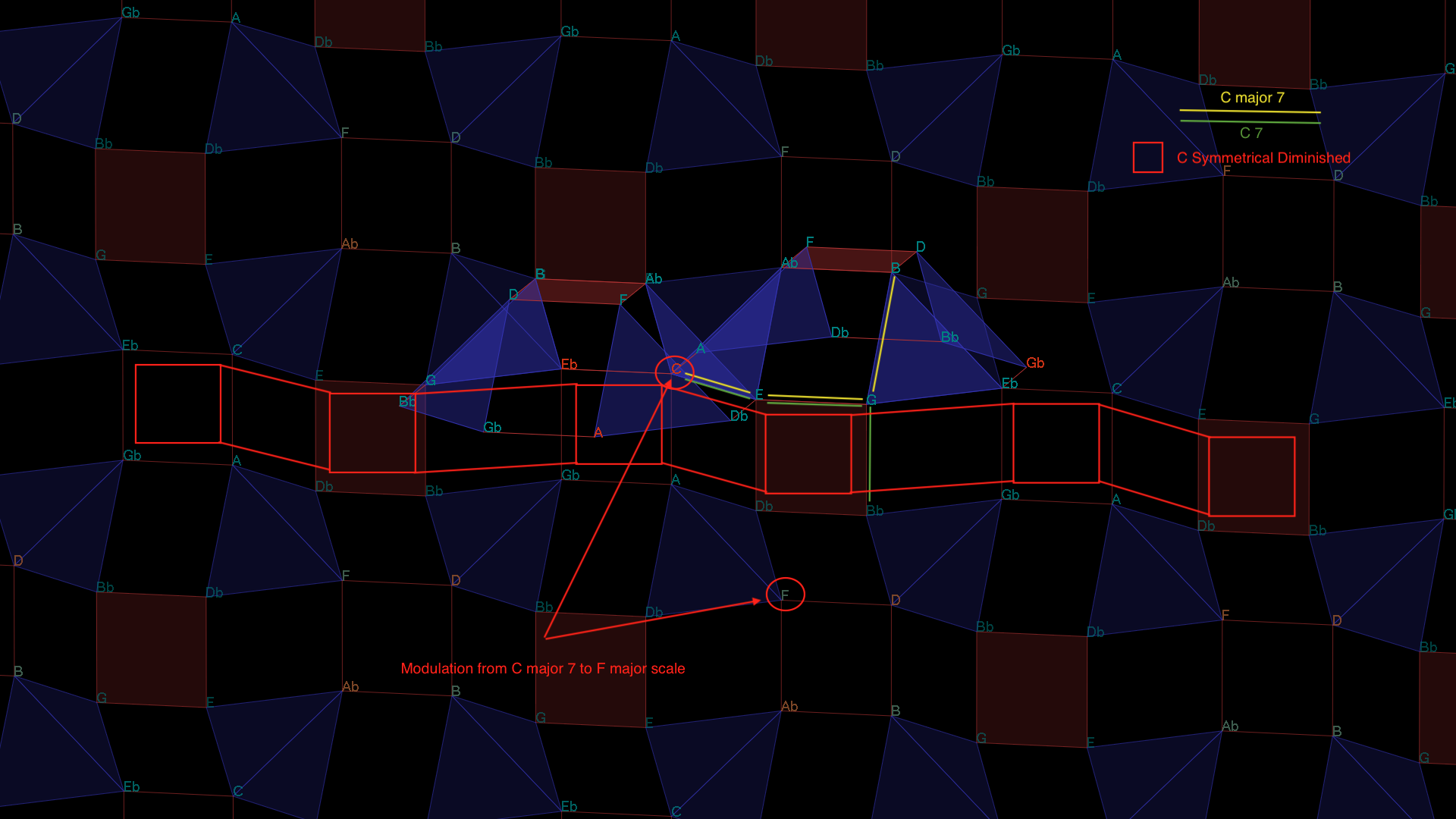
There is the potential to representing the symmetrical diminished scale. I haven't implemented it yet. However, here is a preview of a C symmetrical diminished: C, Db, Eb,E, Gb, G, A, Bb.
fig.28 Symmetrical Diminished Scale In The Diminished System
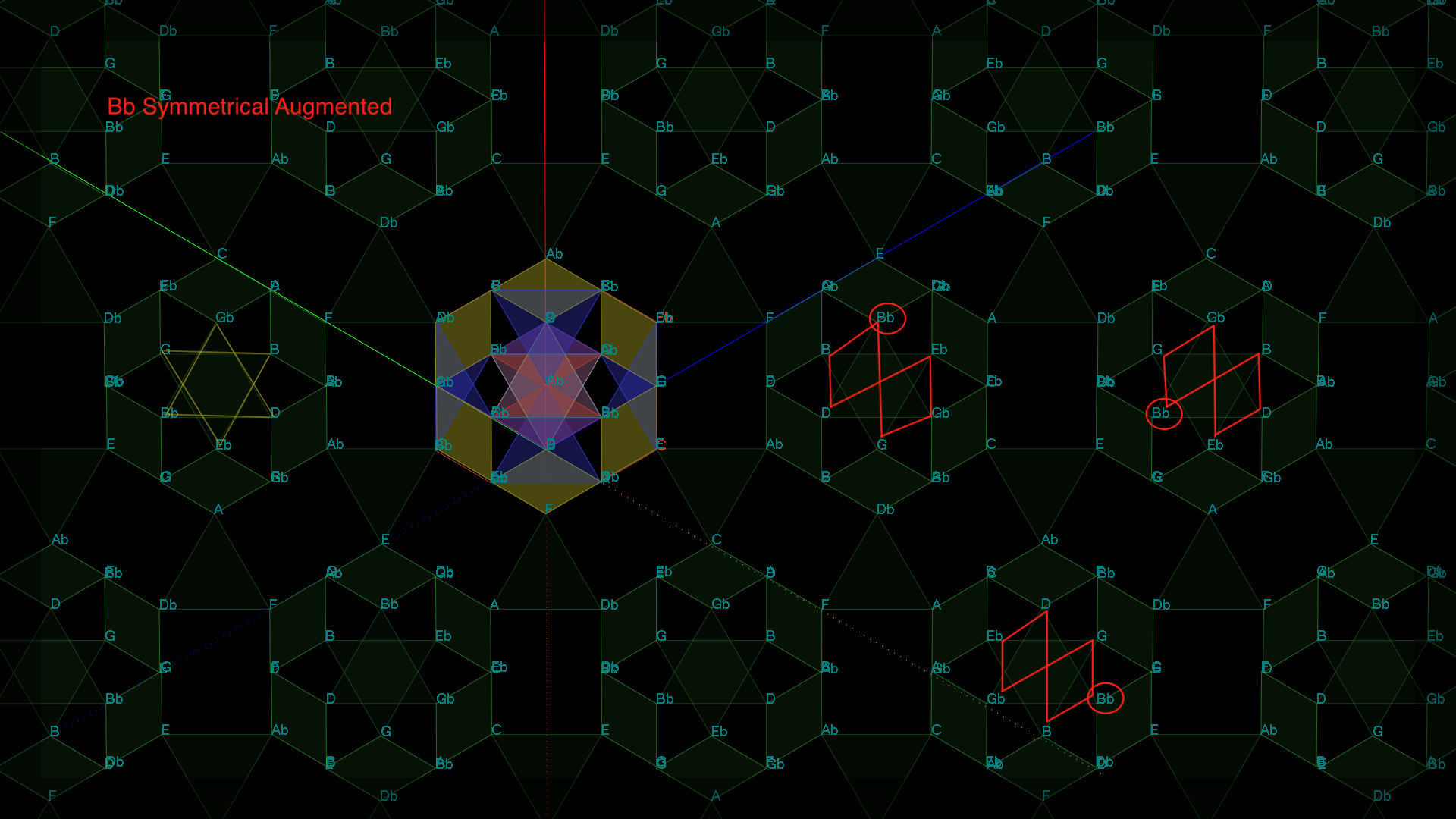
And a preview of Bb symmetrical augmented: Bb, B, D, Eb, Gb, G.
fig.29a Symmetrical Augmented Scale In The Augmented System
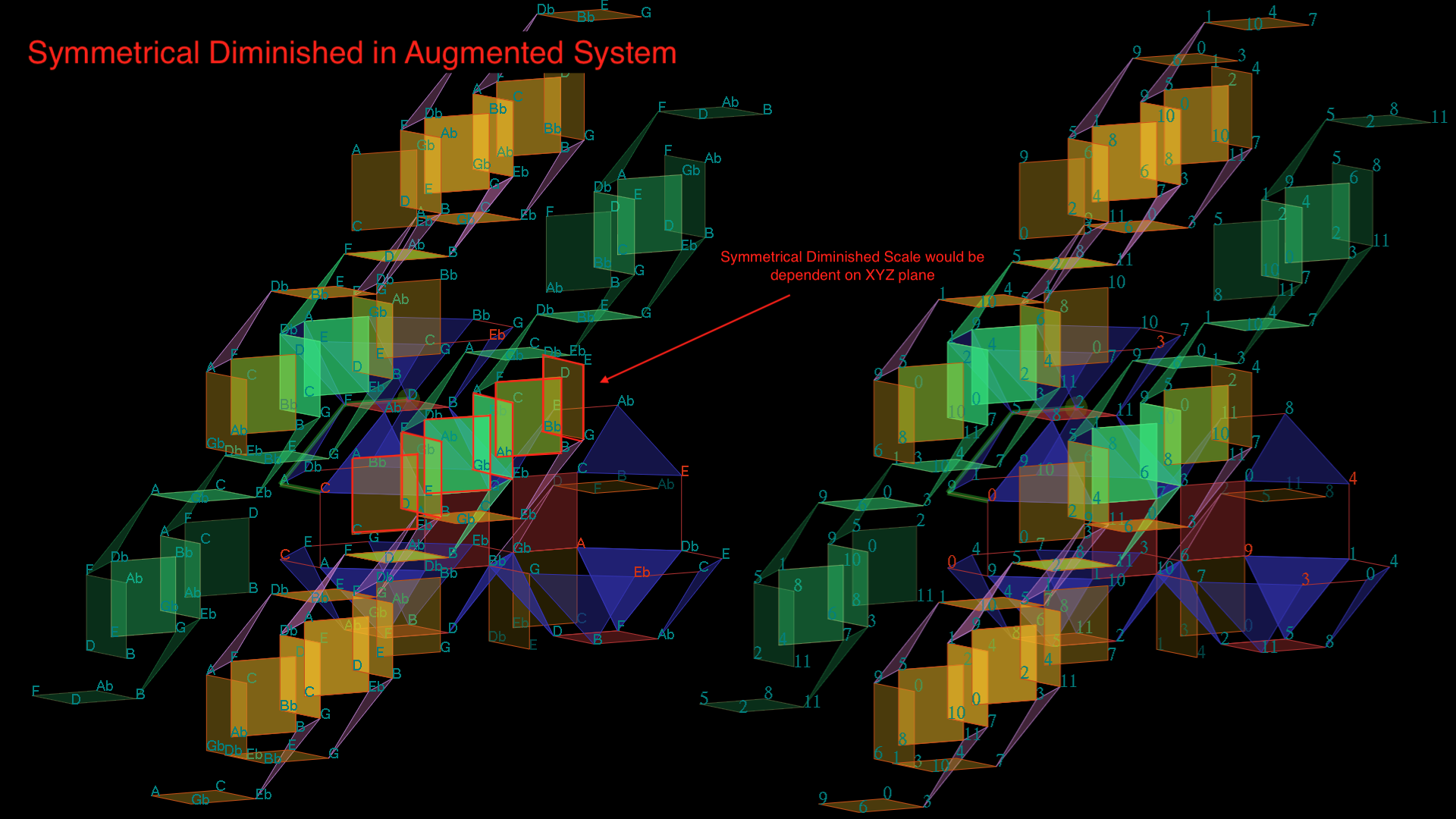
Also, a symmetrical diminished in the augmented system.
fig.29b Symmetrical Diminished In The Augmented System
From One Chord To The Next
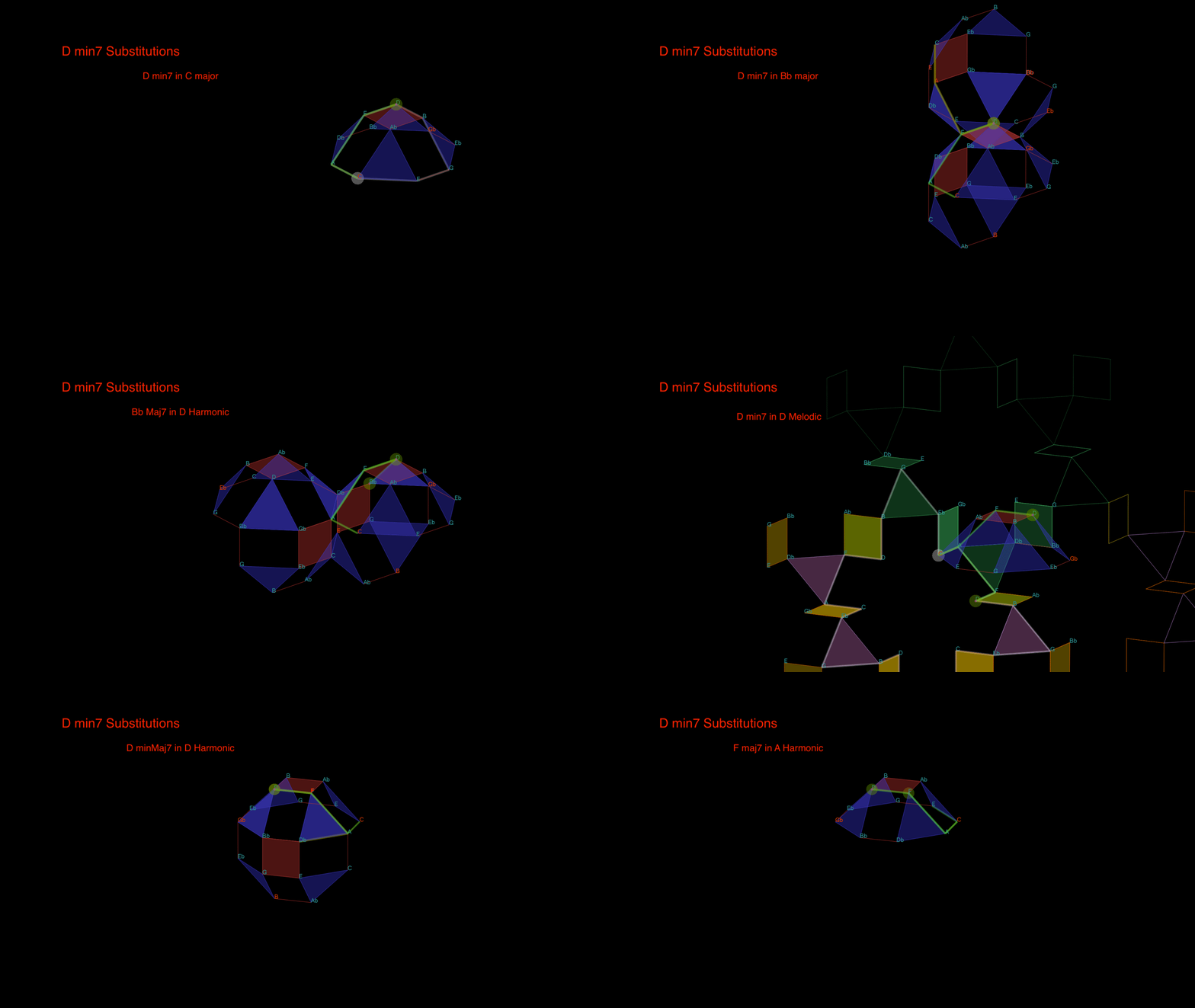
Using the model, software will have to select the view most suited for a substitution, a pivot chords or just a transition from one scale to an other.
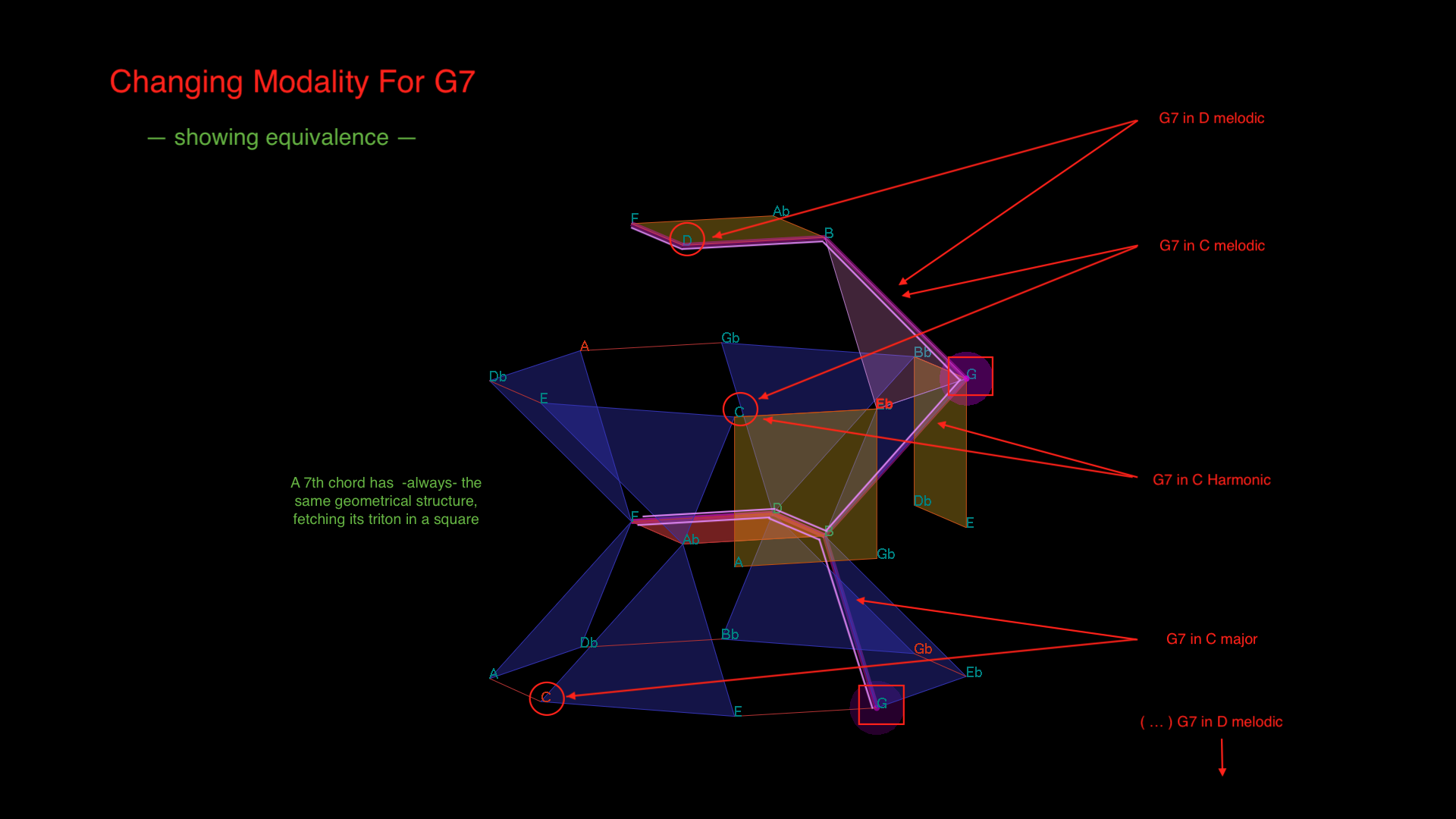
Here I am using different perspective to show either equivalence…
Here I am using different perspective to show either equivalence…
fig.30 G7's Equivalent Structures
…or common tones.
fig.31 Dmin7 Substitutions
One possible use of the model is that a user will be able to lay out her chord progression by simply manipulating the rhombus dodecahedrons and choosing the functionality by selecting its colour. Contextual menu will thin out the possibilities as well as offering suggestions as to which chord voicing and/or substitutions are more appropriate.
fig.32 I-VI-II-V
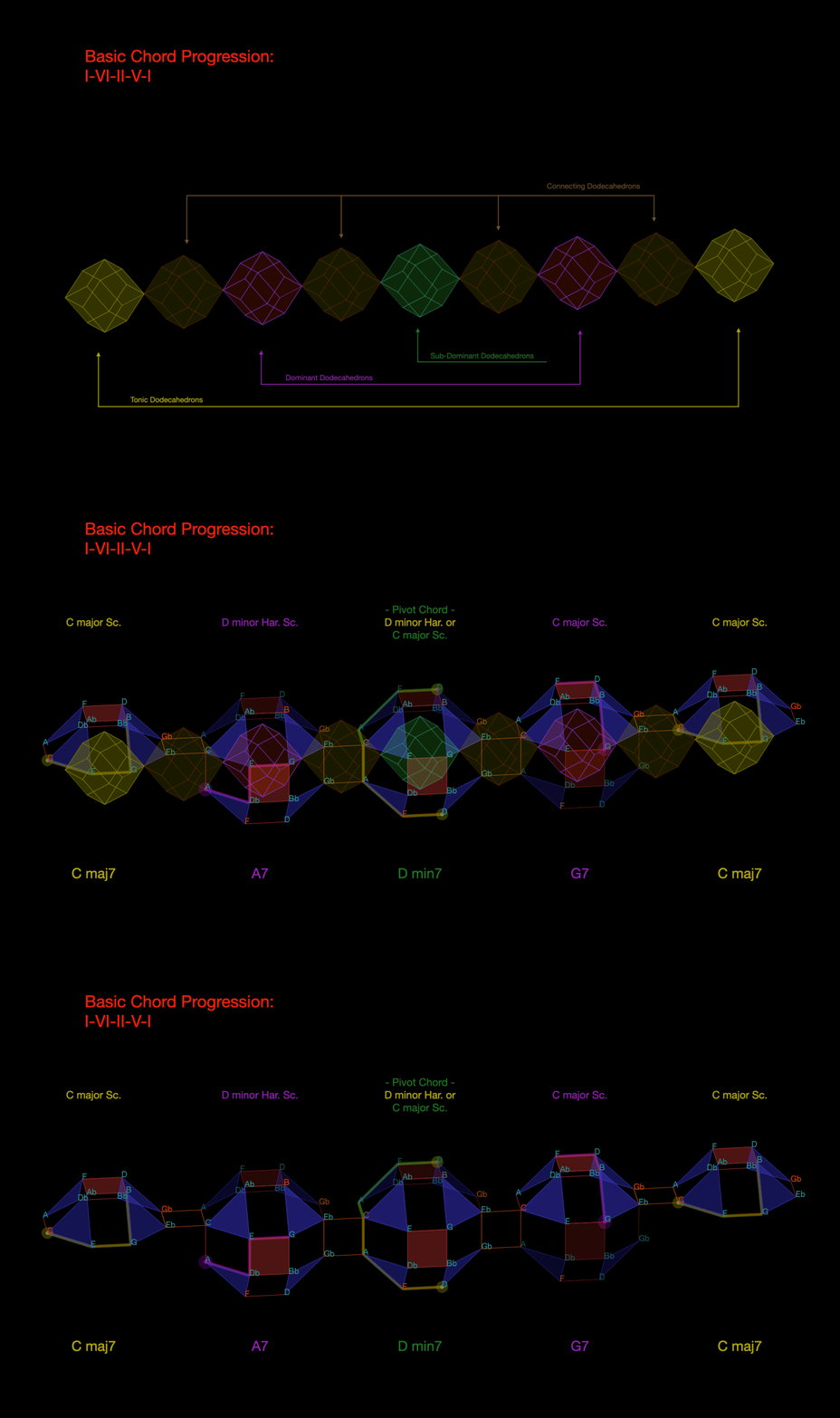
Here is another scenario:
Conclusion
The model can empower anyone to engage in musical endeavors. We can 'see' if a note belong to a given chord or a given scale. We do not have to know how to create that scale or if a particular chord belongs to it; the model does that for us. It provides a plateform for exploring all possibilities, a tremendous help, even for trained musicians. Harmony's functionality is reduce to simple manipulable objects that can greatly help anyone who is not musicaly trained. Scales, chords and functionality are integrated in one interface unlike the traditional systems of notation which can be intimidating, if not forbiding.
It is the perfect companion for a sequencer or a chord dictionary.
It can also be used in classrooms as it offer a very unique perspective on music by 'showing' us: how important the triton is, how diminished and augmented scales intertwine, how four seventh chords relate to one diminished plane! How three augmented seventh chords are one and the same, and much more... It 'shows' us what John Coltrane was after when he wrote 'Giant Steps' !
It is a new system of notation that capture the gesalt unlike the existing linear systems that let the user do the analysis.
It is the perfect companion for a sequencer or a chord dictionary.
It can also be used in classrooms as it offer a very unique perspective on music by 'showing' us: how important the triton is, how diminished and augmented scales intertwine, how four seventh chords relate to one diminished plane! How three augmented seventh chords are one and the same, and much more... It 'shows' us what John Coltrane was after when he wrote 'Giant Steps' !
It is a new system of notation that capture the gesalt unlike the existing linear systems that let the user do the analysis.
The Model's Applications
A Visual Representation Of Music !
The cognitive aspect — Education
Manipulation of 3D objects to create music — Composition
Use of the system's logic to analyse music in real time — Analysis
Manipulation of 3D objects to create music — Composition
Use of the system's logic to analyse music in real time — Analysis
--You can right click: "open in a new tab" and the controls will be visible--
